
There is something happening with UPI that could quietly change the economics of stockbroking in India. And no, I don’t think the real story is the ₹20 you might associate with a ₹1 lakh transfer. The real story is what happens when you multiply that ₹20 across thousands, or even millions, of transactions.
From October 15, 2026, UPI transactions involving stockbrokers, securities and mutual funds will attract a 0.02% Merchant Discount Rate (MDR), capped at ₹300 per transaction. The investor is not supposed to pay this charge directly. At first glance, 0.02% looks almost insignificant. If you transfer ₹1 lakh to your trading account, the MDR works out to just ₹20. On ₹2 lakh, it is ₹40, and on ₹5 lakh, it is ₹100. The ₹300 cap is reached only when the transaction value reaches ₹15 lakh.
So you may wonder, if the investor isn’t directly paying this amount, why should this matter to you? This is where the story gets interesting.
Imagine you transfer ₹2 lakh to your Zerodha, Groww or another brokerage account. You have added money to your trading account, but you don’t necessarily place a trade. The broker has still incurred the payment cost, even though that particular transaction has generated no trading revenue for the broker. Now imagine this happening thousands of times every month.
Zerodha’s Nithin Kamath gave a simple example to explain the scale of the issue. If 10,000 customers make 50 transfers of ₹2 lakh each in a month without placing a single trade, the MDR could cost the broker around ₹2 crore. The individual transaction may look insignificant, but when you look at it at scale, the economics start looking very different.
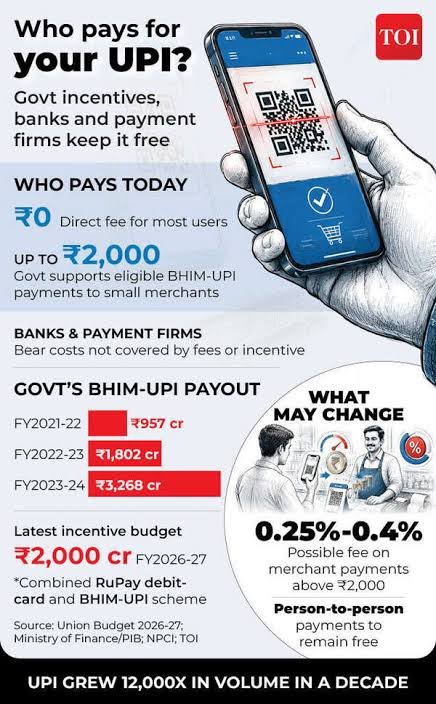
And the scale of India’s digital payment ecosystem makes this even more relevant. In August 2026 alone, UPI processed 24.51 billion transactions worth ₹29.82 lakh crore. Of course, not all of these transactions are related to the capital markets. But the number gives you an idea of the scale at which even a very small transaction cost can become meaningful.
This is also why stockbrokers have raised concerns with SEBI. SEBI Chairman Tuhin Kanta Pandey has said that the regulator will examine the concerns raised by brokers.
For investors, this doesn’t necessarily mean that you will suddenly start paying ₹20 every time you add money to your trading account. The bigger question is what this additional cost means for the brokers themselves.
India’s discount-broking industry has been built around low-cost and, in many cases, zero-brokerage trading. When a broker has to bear a cost every time money enters the system, even when that money doesn’t result in a trade, it changes the economics of that model.
And that, in my view, is the part worth watching.
Because the real story isn’t about ₹20 on a ₹1 lakh UPI transfer.
It is about what happens when a transaction that generates no revenue for a broker starts generating a cost.