
Why Do We Sell Winning Stocks Too Early but Hold Losing Stocks Forever?
Introduction: The Stock Market Has a Funny Way of Testing Us
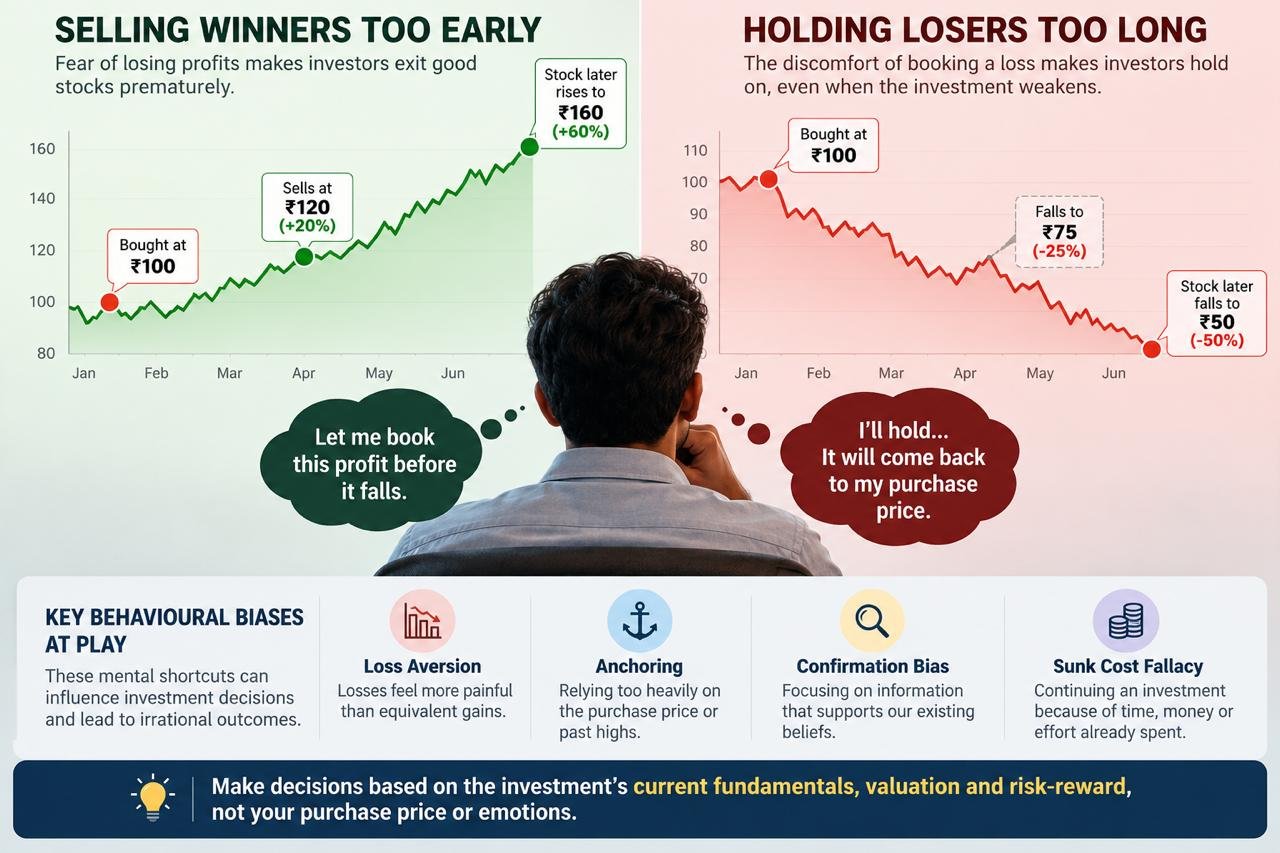
You buy a stock at ₹100. It rises to ₹120, and suddenly you’re scared of losing your ₹20 profit. You sell.
Two weeks later, the stock reaches ₹150. Now you’re checking the chart like it personally betrayed you.
Meanwhile, another stock you bought at ₹100 falls to ₹70. Do you sell? No!
“Long-term investment hai. Recovery toh aayegi!”
And just like that, a short-term trade becomes a long-term investment.
Funny, right? But this behaviour has a psychological explanation. It’s called investor psychology and behavioural biases.
Let’s understand why our brains sometimes make investing harder than it needs to be.
1. Loss Aversion: We Hate Booking Losses
Imagine investing ₹20,000 in a stock. Its value falls to ₹15,000.
You’re down ₹5,000, but instead of reviewing the company, you tell yourself, “I’ll sell when it comes back to my buying price.”
This is called loss aversion the tendency for losses to feel more painful than equivalent gains feel satisfying.
We happily book small profits but hesitate to accept losses, hoping the market will give us another chance.
Here’s the catch: the stock doesn’t know your purchase price. It isn’t waiting for you to break even!
The lesson: Don’t hold a stock just because selling it hurts. Evaluate whether the investment still makes sense today.
2. Anchoring Bias: ₹500 Is Stuck in Your Head
You bought a stock at ₹500. Today, it’s trading at ₹350.
Your first thought? “It was ₹500 earlier. Surely, it’ll recover!”
Not necessarily.
This is anchoring bias—when we become too attached to a reference point, such as our purchase price or a stock’s previous high.
The company may have stronger competition, declining profits or other business problems. Its past price doesn’t guarantee a recovery.
Remember: Your purchase price tells you what you paid, not what the stock is worth today.
3. Why Do We Sell Winners Too Early?
Three things often influence this decision:
Fear: “What if my profit disappears tomorrow?”
Ego: Booking a profit feels like proof that we were right.
Regret: We want to avoid watching a profitable stock fall after we sell.
Sometimes, selling is the right decision. But selling simply because you’re afraid of losing a profit can mean missing further gains.
Booking profits isn’t the problem. Making decisions without considering your investment strategy is.
4. Why Do We Hold Losing Stocks Forever?
Three other biases can keep us stuck.
The sunk cost fallacy: “I’ve already lost ₹20,000. I can’t sell now!” But money already lost doesn’t automatically justify holding the remaining investment.
Confirmation bias: You search for positive news about your stock and ignore reports highlighting its problems. Congratulations, you’ve turned Google into your personal cheerleader!
Overconfidence: You assume the stock will return to its previous high simply because it traded there before. Unfortunately, past prices aren’t promises.
5. How Can You Avoid These Mistakes?
Try these four practical steps:
1. Write down why you bought the stock. Identify the factors that would make you reconsider your decision.
2. Review your investment objectively. Would you buy it at today’s price based on its current fundamentals, valuation and risks?
3. Stop averaging down blindly. A lower price doesn’t automatically mean a better investment.
4. Maintain an investment journal. Record why you buy, hold and sell. Reviewing your decisions can reveal repeated emotional patterns.
Remember, a falling stock isn’t automatically bad, and a profitable stock isn’t automatically worth holding. Every investment deserves an objective assessment.
Conclusion: Stop Arguing with Your Portfolio
Selling winners too early and holding losers too long often come from the same problem: we want to avoid regret and prove our earlier decisions were correct.
But the market doesn’t care about your purchase price, your expectations or how long you’ve been waiting.
The goal isn’t to be right every time. It’s to make decisions based on evidence rather than emotions.
Because successful investing isn’t just about analysing the market. It’s also about understanding yourself.